worker
★ ICH ★
cooperatives
since 1957
VOL. I · NO. 02
DEC '95 EDITION
a typewritten travelog·printed in mono·read on a sunday
lastanalogtraveler
field notes from the slow lane

This is a travelog typed on an Olivetti, glued into a notebook, and scanned only because someone insisted. It is not a guidebook. It is a collection of analog memories gathered across India — where mountains remember older names, temples carry centuries of whispered prayers, the sea tells the same stories to every generation, forests keep their own silence, and forgotten cafés still serve conversations as faithfully as coffee.

Some journeys ahead begin with the aroma of an Indian Coffee House — the country's oldest still-running restaurant chain, founded in 1957 by sacked coffee-board workers who decided, quite calmly, to start their own cooperative. Others follow old railway lines, winding hill roads, crumbling forts, sleepy villages, rain-soaked coastlines, or streets where time seems to have politely slowed down. This is for those who still believe that travel is less about checking destinations off a list and more about collecting moments that cannot be downloaded — places with history, people with stories, and landscapes that leave behind a feeling long after the journey ends. Welcome to the trails where nostalgia is the destination, nature is the companion, and every mile is delightfully, unapologetically analog.

1990s Era Travel Items - School Supplies

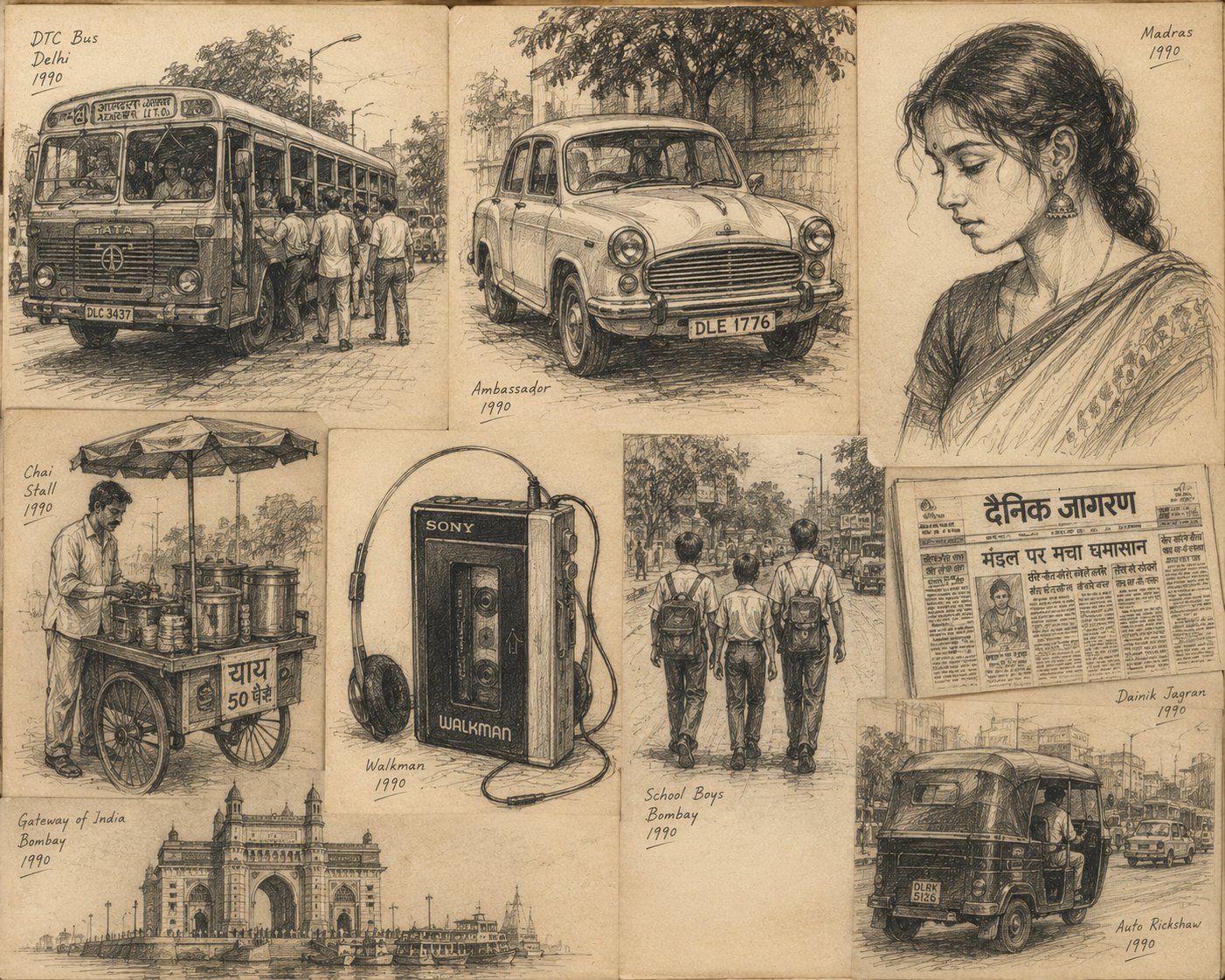
School essentials · street scenes

1990s Era Travel - Transportation & Daily Life

Transport · urban sketches

Contents of This Volume

I.Trail the First — Central Indian Loop, Ahmedabad to the Coal Beltp. 09
II.Trail the Second — Kerala Coast, in Three Coffee Housesp. 31
III.Trail the Third — The Mountain Trail, Madhya Pradeshp. 49
IV.Trail the Fourth — Centuries of Whispered Prayersp. 63
V.Trail the Fifth — The Sea Tells the Same Storiesp. 77
VI.Trail the Sixth — Forests That Keep Their Own Silencep. 91
VII.Colophon & the Analog Manifestop. 103

The Travelers

Brothers. Engineers. Nostalgia Hunters.
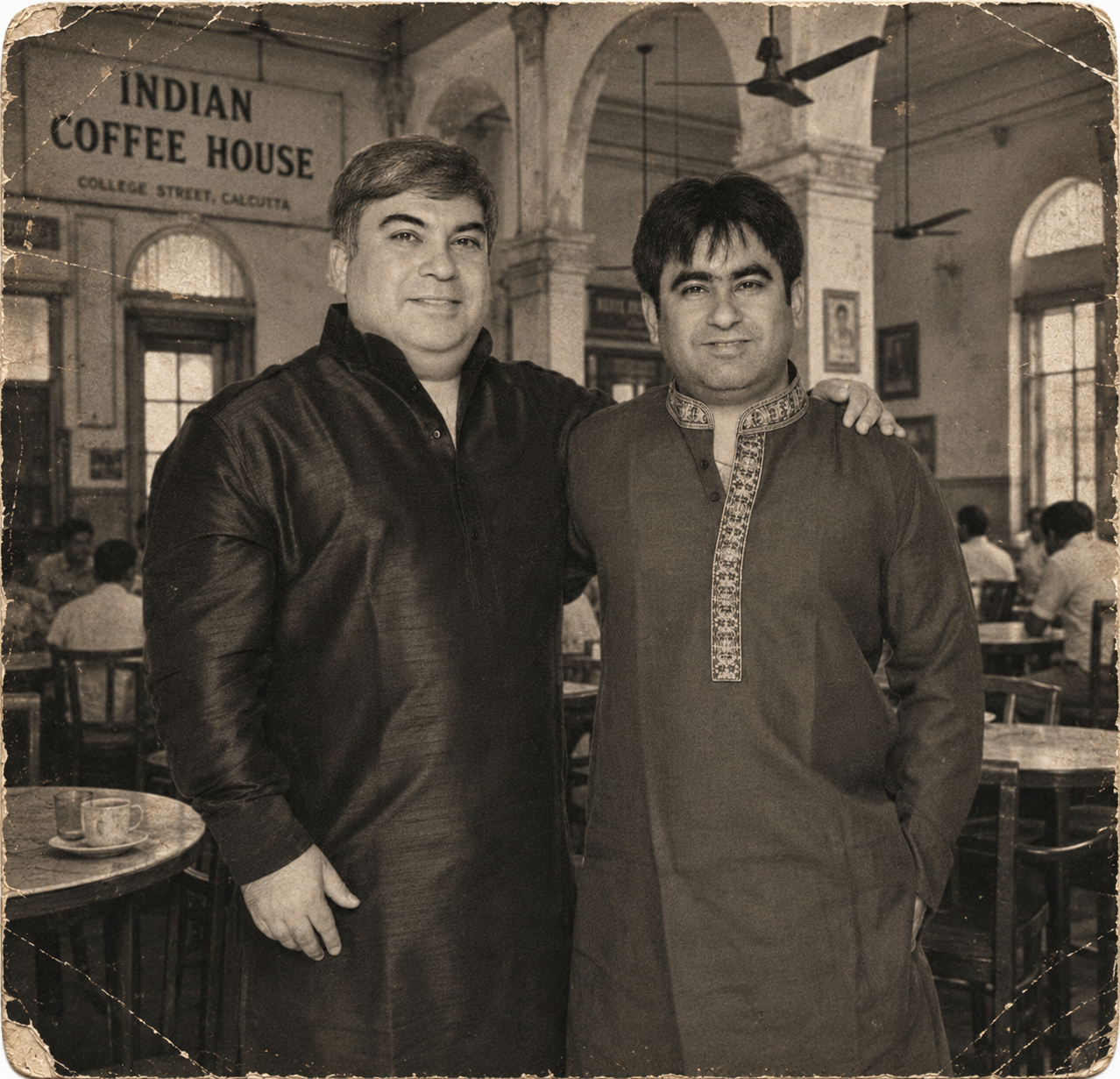
The Brothers at Indian Coffee House, Calcutta

Indian Coffee House, Calcutta

Born and brought up in the warm PSU colony culture of BALCO, Korba. Raised amidst red oxide floors, colony cricket grounds, cycle rides at dusk, Doordarshan evenings, Kendriya Vidyalaya uniforms, annual functions, workshop sirens, and the unmistakable smell of monsoon on factory roads.

One became an Electrical Engineer.
The other, a Mechanical Engineer.

But beyond careers, deadlines, and adulthood, they carried something far more valuable — memories of a slower India.

An India of:

  • Steel tiffin boxes
  • Railway platform chai
  • Sunday market cassette stalls
  • Bajaj scooters
  • Handwritten inland letters
  • And the legendary Indian Coffee House conversations that shaped generations

The Trails

six journeys · mountains, temples, sea, forests & coffee houses

Each trail below is a loop or a line drawn across a slower India — two of them strung between branches of the Indian Coffee House, the rest following hill roads, temple towns, tide lines, and forest tracks. There are no detours to "must-see" attractions, no sponsored stays, no curated experiences. There is only the next stop, the next story, the next slow afternoon.

Trail · 01

The Central Indian Loop

~8 days · 6 stops · ≈ 3,200 km · Ahmedabad return

From Gujarat into Maharashtra, through Madhya Pradesh, deep into Chhattisgarh's steel and coal country, and home again. Six coffee houses, most of them run by the Jabalpur cooperative society. The route is shaped roughly like a teardrop, which is appropriate.

AMD → Nagpur → Jabalpur → Bilaspur → Korba → Raipur → Bhilai → AMD
Open trail ▸
Trail · 02

The Kerala Coast, in Three

~5 days · 3 stops · ≈ 340 km · south to north

Three coffee houses in the state where the southern cooperative society was born — including the Laurie Baker red-brick spiral in Trivandrum, the busy mainland-Kochi flagship at Ernakulam, and the hometown branch in Thrissur, registered office of Society No. 4227.

Trivandrum → Ernakulam (Kochi) → Thrissur
Open trail ▸
Trail · 03

The Mountain Trail — Madhya Pradesh

~8–10 days · 6 stops · ≈ 900–1,000 km · Bhopal to Amarkantak

Where the Satpuras whisper and rivers are born. From the sacred Maikal Hills of Amarkantak to the mist-covered plateaus of Pachmarhi, following the mountain systems that shaped Madhya Pradesh's rivers, forests, tribes, and history.

Bhopal → Bhimbetka → Pachmarhi → Tamia → Patalkot → Satpura NP → Amarkantak
Open trail ▸
Trail · 04

Centuries of Whispered Prayers

notes still being transcribed · temple towns

Gopurams at dawn, oil lamps, stone corridors worn smooth by footsteps older than memory. A trail through temple towns where the architecture itself seems to keep time.

field notes pending · check back in the next edition
Open trail ▸
Trail · 05

The Sea Tells the Same Stories

notes still being transcribed · rain-soaked coastlines

Fishing harbours, lighthouse towns, and the particular hush of a coastline in the monsoon. Boats, salt air, and conversations that drift the way tides do.

field notes pending · check back in the next edition
Open trail ▸
Trail · 06

Forests That Keep Their Own Silence

notes still being transcribed · sal & teak country

Forest rest houses, watchtowers, and roads where the canopy closes overhead. A quieter trail, still being walked before it is fully written.

field notes pending · check back in the next edition
Open trail ▸
← back to the trails   ·   trail one · central indian loop
Trail the First

The Central Indian Loop

Ahmedabad → Nagpur → Jabalpur → Bilaspur → Korba → Raipur → Bhilai → Ahmedabad

The Route, Hand-Plotted

Sketched from a 1998 road atlas. Distances honest, scale approximate.
N AHMEDABAD ★ start / end NAGPUR ICH · Mount Rd / Sadar JABALPUR ICH · Malviya Marg (HQ) BILASPUR ICH · Vyapar Vihar KORBA ICH · TP Nagar RAIPUR ICH · G.E. Road BHILAI ICH · Supela / Sec 10 TRAIL 01 · CENTRAL LOOP scale: approximate. spirit: exact.
start & end ICH stop trail route (clockwise)
INDIAN COFFEE HOUSE
14 · 11 · '94
Stop 01 · Maharashtra

Nagpur — Indian Coffee House, Mount Road (Sadar)

Mount Rd, near Smriti Theatre, Liberty Chowk, Sadar — 440 001

The room is a small monument. Generations of Nagpur grew up here, the junction outside is named after it, and the white-uniformed waiters know the regulars by what they order. Marble-topped tables, slow ceiling fans, bridge games at the back. Light enters at an exact 1970s angle. The cutlet is sharper than you remember.

Filter coffee × 212.00
Masala dosa14.00
Veg cutlet10.00
Butter toast (egg)16.00
Total52.00
left here unable to remember what year it was
INDIAN COFFEE HOUSE
17 · 11 · '94
Stop 02 · Madhya Pradesh

Jabalpur — Indian Coffee House, Malviya Marg

592 Malviya Marg, Jabalpur (MP) — 482 002

The mothership. Jabalpur is home to the Indian Coffee Workers' Co-operative Society Ltd., founded in 1958 with a starting capital of Rs. 1,365 and sixteen members. The Malviya Marg branch is the oldest in town — high ceilings, faded green walls, a menu card that politely apologises for price revisions. This trail's true centre of gravity.

Mutton dosa32.00
Cold coffee14.00
Idli vada12.00
Veg cutlet10.00
Total68.00
society HQ. asked at the till — they let me see the 1958 ledger
INDIAN COFFEE HOUSE
20 · 11 · '94
Stop 03 · Chhattisgarh

Bilaspur — Indian Coffee House, Vyapar Vihar

Vyapar Vihar Road, near Old Bus Stand, Bilaspur (CG)

Smaller, busier, more workmanlike than its older cousins. Office-workers in the morning, students by afternoon, families on Sunday. The Bilaspur cutlet has a particular variety — beetroot-pink in the middle, served with a green chutney and an inexplicable single fried curry leaf perched on top like a hat.

Filter coffee6.00
Veg cutlet10.00
Mushroom omelette22.00
Cheese masala dosa20.00
Total58.00
curry leaf on the cutlet — still thinking about it
HOTEL INDIA · ICH
22 · 11 · '94
Stop 04 · Chhattisgarh

Korba — Indian Coffee House / Hotel India

ICH attached to Hotel India, TP Nagar / NTPC area, Korba (CG)

The most industrial coffee stop on the trail. Korba runs on power plants and the coffee house sits inside that orbit — engineers in blue half-sleeves, contractors with rolled-up site plans, coffee delivered to the table in a thermos. The Jabalpur society also runs a Hotel India lodge upstairs, so you can sleep above your dosa.

Filter coffee (thermos)14.00
Boiled egg + toast12.00
Mutton curry rice38.00
Total64.00
slept upstairs. ₹120 the room, included one filter coffee
INDIAN COFFEE HOUSE
25 · 11 · '94
Stop 05 · Chhattisgarh

Raipur — Indian Coffee House, G.E. Road

G.E. Road, near Jaistambh Chowk, Raipur (CG)

The Raipur main branch is one of the busiest in central India. A long hall with two rows of bolted-down tables, ceiling fans on the second-highest setting, and waiters who can carry seven coffees in a single tray without spilling a drop. There is a newer New Raipur outlet too (cleaner, calmer) but the G.E. Road one is the real one. Order anything that involves egg.

French toast16.00
Scrambled egg / toast14.00
Masala dosa14.00
Filter coffee × 212.00
Total56.00
28 tables. counted while waiting for the dosa
INDIAN COFFEE HOUSE
27 · 11 · '94
Stop 06 · Chhattisgarh

Bhilai — Indian Coffee House, Supela

Supela, Bhilai (CG) — also branches in Sector 10

The steel-city closer. Bhilai is where the last filter coffee of the trail is drunk before the car points west toward Gujarat. The Supela branch shares premises with Hotel India and pulls the same mixed crowd: SAIL retirees, weekend families, somebody always reading a Hindi newspaper folded into precise fourths.

Filter coffee (strong)6.00
Masala dosa14.00
Plum cake (Dec only)15.00
Total35.00
turning west tomorrow. ~1,200 km left to AMD
← back to the trails   ·   trail two · kerala coast, in three
Trail the Second

The Kerala Coast, in Three

Trivandrum → Ernakulam (Kochi) → Thrissur

The Route, South to North

Drawn following the railway line. The Arabian Sea is on the left.
~ palm ~ ~ palm ~ ~ palm ~ TRIVANDRUM ICH · Thampanoor (the spiral) ERNAKULAM (KOCHI) ICH · MG Road / Park Avenue THRISSUR ICH · Round South (society HQ) arabian sea N TRAIL 02 · KERALA COAST south to north · ~340 km · 3 stops
start (Trivandrum) ICH stop trail route (northbound)
INDIAN COFFEE HOUSE
04 · 02 · '95
Stop 01 · Kerala

Trivandrum — Indian Coffee House, Thampanoor

Central Station Rd / Thampanoor, near KSRTC Bus Stand, Thiruvananthapuram — 695 001

The most famous coffee house in India. Designed by the architect Laurie Baker as a continuous red-brick spiral — you eat your dosa walking gently uphill, then walk gently down again. No two tables are at the same height. Locals do not think about this; tourists keep tilting their heads. Cheap, fast, perfect.

Masala dosa14.00
Vada × 28.00
Filter coffee6.00
Meals (lunch)28.00
Total56.00
architect: Laurie Baker. building: 1990. the table tilts, you don't
INDIAN COFFEE HOUSE
07 · 02 · '95
Stop 02 · Kerala

Ernakulam (Kochi) — Indian Coffee House, MG Road / Park Avenue

MG Road / Park Avenue, Ernakulam — short walk from the boat jetty

The mainland-Kochi flagship. A long shaded hall a few minutes from the Ernakulam boat jetty — exactly the kind of place a traveller slips into between catching a ferry to Fort Kochi and a train at Ernakulam Junction. Strong south Indian breakfast game, and one of the better non-veg menus in the chain. Look for the Kerala-style chicken curry at lunch.

Parotta + chicken curry34.00
Masala dosa14.00
Cold coffee14.00
Pazhampori (4 pm)6.00
Total68.00
caught the 4:30 ferry to Fort Kochi after this
INDIAN COFFEE HOUSE
10 · 02 · '95
Stop 03 · Kerala

Thrissur — Indian Coffee House, Round South

Round South, near Thrissur Corporation, Thrissur — 680 001

The hometown branch. Thrissur is where the Indian Coffee Board Workers' Co-operative Society Ltd. No. 4227 was registered in 1958 — this city is the registered office of the entire Kerala chain. Sit at a window on the Round, watch the buses do their slow lap around the maidan, and order what the founders would have ordered.

Filter coffee + neyyappam14.00
Ghee roast dosa18.00
Meals (lunch)30.00
The framed billkept
Total62.00
society no. 4227. registered 1958. still going.
← back to the trails   ·   trail three · madhya pradesh mountains
Trail the Third

The Mountain Trail — Madhya Pradesh

Where the Satpuras Whisper and Rivers Are Born

There are mountains that invite conquest, and there are mountains that invite contemplation. This trail is not about reaching summits — it is about landscapes where forests breathe, rivers begin, temples emerge from stone, and time moves with the rhythm of nature. From the sacred Maikal Hills of Amarkantak to the mist-covered plateaus of Pachmarhi, it follows the ancient mountain systems — Satpura, Vindhya, Maikal — that have nurtured civilisations, inspired saints, sheltered wildlife, and quietly witnessed centuries of history.

The Route, Hand-Plotted

Bhopal → Bhimbetka → Pachmarhi → Tamia → Patalkot → Satpura NP → Amarkantak  ·  ≈ 900–1,000 km  ·  8–10 days  ·  best Oct–Mar (monsoon for waterfalls)
N BHOPAL ★ gateway city BHIMBETKA rock shelters PACHMARHI Queen of the Satpuras TAMIA hidden plateau PATALKOT Bharia tribal valley SATPURA N.P. Denwa river AMARKANTAK Maikal Hills · river source TRAIL 03 · MOUNTAIN TRAIL, MP scale: approximate. spirit: exact.
gateway / turnaround trail stop suggested route
day 2
Stop 01 · Raisen district

Bhimbetka Hills

UNESCO rock shelters · humanity's earliest artists
  • UNESCO Rock Shelters
  • Sandstone formations
  • Forest walks
  • Ancient cave paintings

Although celebrated for their prehistoric rock shelters, Bhimbetka is equally a mountain landscape where humanity's earliest artists found inspiration.

Stand before a painting created thousands of years ago and reflect on how little the mountains themselves have changed.

day 3
Stop 02 · the Satpuras

Pachmarhi — Queen of the Satpuras

Madhya Pradesh's only hill station
  • Dhoopgarh
  • Bee Falls
  • Duchess Falls
  • Jata Shankar Cave
  • Pandava Caves
  • Christ Church
  • Priyadarshini Point

More than a summer retreat, Pachmarhi is a harmonious blend of colonial heritage, mythology, sandstone caves, waterfalls, and dense forest — capped by Dhoopgarh, the highest peak in the state.

Watch the sunset from Dhoopgarh without reaching for your phone. The changing colours of the Satpura hills are a reminder that some spectacles are meant to be experienced, not captured.

day 5
Stop 03 · the hidden plateau

Tamia

one of MP's least-known mountain escapes
  • Patalkot Valley Viewpoint
  • Sunset Point
  • Colonial Rest House
  • Tribal villages
  • Forest drives

Tamia overlooks deep valleys and endless forest, largely unvisited — a plateau reached by roads that seem to have been carved for exactly this purpose and no other.

Spend an evening on the veranda of the old rest house, watching fog drift through the valley while the world below slowly disappears into darkness.

day 6
Stop 04 · the Bharia homeland

Patalkot Valley

horseshoe-shaped valley · deep gorges
  • Tribal settlements
  • Medicinal plants
  • Deep gorges
  • Mountain trekking
  • Cultural experiences

A horseshoe-shaped valley inhabited by the Bharia tribe, where traditional knowledge and mountain life continue with remarkable resilience, largely on their own terms.

Walk quietly through the valley and let local stories reveal a world that has remained hidden from hurried travellers.

day 8
Stop 05 · Denwa river country

Satpura National Park

one of India's oldest mountain ranges, remarkably untouched
  • Boat safari on Denwa River
  • Walking safaris
  • Forest lodges
  • Ancient teak & sal forests
  • Rich birdlife & wildlife

The Satpuras are among India's oldest mountain ranges, sheltering forests that remain remarkably untouched — and among the very few Indian parks where a walking safari is actually permitted.

Listen to the forest at sunrise. Before engines, notifications, and traffic, this was the soundtrack of India.

day 10
Stop 06 · Maikal Hills

Amarkantak — Where Rivers Begin

source of the Narmada, Son & Johila rivers
  • Narmada Udgam Kund
  • Kalachuri Temple Complex
  • Kapildhara Waterfall
  • Dudh Dhara Falls
  • Mai Ki Bagiya
  • Sonmuda Viewpoint

Nestled where the Vindhya and Satpura ranges meet, Amarkantak is one of India's most sacred mountain landscapes. It is here the mighty Narmada begins its westward journey, while the Son and Johila rivers flow east from the very same hill.

Wake before dawn and walk to the Narmada Udgam. As temple bells echo through the mist and the first light touches the hills, you'll understand why some journeys begin with silence.

— Mountain Trail Journal —

  1. Collect the fragrance of wet earth after rain.
  2. Collect the sound of temple bells echoing through valleys.
  3. Collect handwritten entries in forgotten forest guest books.
  4. Collect conversations over tea with strangers who know every bend of the mountain road.
  5. The Satpuras are not merely mountains — they are living archives of Central India.
  6. Rivers are born here. Forests endure. Memories remain beautifully analog.
← back to the trails   ·   trail four · temples
Trail the Fourth

Centuries of Whispered Prayers

gopurams at dawn · stone corridors — notes still being transcribed
notes pending
Stop 01 · a temple town, unnamed for now

An entry still being deciphered

details to be confirmed against the original notebook

What's clear so far: a gopuram at first light, the smell of camphor and crushed jasmine, and a corridor of pillars worn smooth by generations of bare feet. The names, dates, and directions are being checked before they're added — this cooperative doesn't publish anything it hasn't verified in person.

back soon — with the rest of the page
← back to the trails   ·   trail five · the sea
Trail the Fifth

The Sea Tells the Same Stories

fishing harbours · lighthouse towns — notes still being transcribed
notes pending
Stop 01 · a coastline, unnamed for now

An entry still being deciphered

details to be confirmed against the original notebook

A lighthouse, a fishing harbour smelling of salt and diesel, and a monsoon that arrived while the notes were being taken — which explains the smudged ink on this page. The boats, the names of the villages, and the receipts are being sorted out before they go up here.

back soon — with the rest of the page
← back to the trails   ·   trail six · forests
Trail the Sixth

Forests That Keep Their Own Silence

sal & teak country · forest rest houses — notes still being transcribed
notes pending
Stop 01 · a forest, unnamed for now

An entry still being deciphered

details to be confirmed against the original notebook

A forest rest house, a watchtower, and a canopy that closed overhead somewhere past the second checkpoint. The silence here was the whole point, so the notes are shorter than usual — and slower to transcribe for exactly that reason.

back soon — with the rest of the page

About / Colophon

on the publication, and the manifesto behind it

This is a travel notebook for a slightly slower, slightly more deliberate way of moving through India. We carry a paper map, write in ballpoint, and chase the kind of places that still keep a brass bell on the counter. The text you are reading was first typed on an Olivetti Lettera 32 between train stations.

Each trail in this volume is built around a different kind of memory — mountains that remember older names, temple towns that carry centuries of whispered prayers, coastlines the sea keeps telling the same stories to, and forests that keep their own silence. Two of the trails, so far, are built around a subject with a memory of its own: the Indian Coffee House — the largest worker-owned restaurant chain in the world, founded in 1957 when the Coffee Board sacked its staff and the staff, quite calmly, replied by starting their own cooperative society. The first new-generation branch opened in Delhi on 27 December 1957. By the end of 1958 the chain reached Nagpur, Jabalpur, Pondicherry, Thrissur, Lucknow, Mumbai, Kolkata, Tellicherry, and Pune.

Two regional cooperatives carry those particular trails: the Indian Coffee Workers' Co-operative Society Ltd., Jabalpur, which runs the central Indian outlets in Trail 01, and the Indian Coffee Board Workers' Co-operative Society Ltd. No. 4227, Thrissur, which runs the Kerala outlets in Trail 02. The remaining trails — mountains, temples, sea, forests — are still being transcribed from a second notebook, and will be added a page at a time.

Every stop on these trails was visited in person, paid for in cash, and recorded the same evening. None of it is sponsored. None of it is reviewed. It is simply visited, in order, like saints on a pilgrimage.

— The Analog Manifesto —

  1. We carry a paper map. It folds.
  2. We eat where the locals have eaten for forty years.
  3. We say yes to filter coffee. Twice.
  4. We do not review. We visit.
  5. We thank the waiter, the priest, the boatman, and the ranger by name when we know it.
  6. Nostalgia is the destination, nature is the companion, every mile is unapologetically analog.